Skip the Social

I dislike large groups. “The more the merrier” doesn’t ring true.

It’s not that I don’t like the people in large group. Many can be close friends or relatives.  But I don’t care for the social dynamics and structure that large groups dictate. Large groups are made up of smaller groups, and I nearly always find myself on the outside looking in at these smaller groups of people ripping Obama or health care reform or Facebook or whatever. Since I find it difficult to keep my mouth shut, it’s best I avoid them and head to an area with better 3G service.

I’m not referring to large conferences with hundreds or thousands of people. It’s easy to remain anonymous in that size group. Those don’t bother me.

I’m talking about the company Christmas party, family reunion or church banquet. I know it sounds odd because those occasions are meant to bring people together. But I can’t stand them.

I find these situations incredibly awkward. I’d avoid them altogether, but that’s impossible with young children. I don’t want to deprive them of the opportunity to meet family or make new friends just because I’d rather be organizing my sock drawer.

Kim and I seldom argue. But when we do it’s usually been over my desire to skip a family or church gathering.  If I’m unable to make up an excuse fast enough, I’ll attend and pull out my iPhone or wander the building looking for a janitor listening to sports on his radio.

My mother-in-law and my father love getting large groups of people together. Nothing makes them happier than to gather the family together for an activity that ends with a group photo. I have to remind myself that these gatherings make them happy, and my kids enjoy attending them.

A couple years ago, my father took over 30 people in our family to Disneyland. It was our kids first time to the park, and they had a blast. But we spent very little time with other members of my family. It was if we’d gone on our own which was fine with me, but I feel my kids missed a rare opportunity to spend time with their cousins. Living in Seattle while everyone else lives in Utah creates an unintended barrier between us.

As awkward as I feel in large groups, I’m good one on one. I love nothing more than getting together with a friend and talking for two hours over dinner. I’m looking forward to doing just that tonight with a close friend I haven’t seen in a few months.

Last week, my brother-in-law from St. George and I got talking after the fireworks on the 4th and didn’t stop until 5 am. It was a lot of fun to get to know him better. We have more in common that I imagined.  Had he not broken off from the group and found me downstairs with my laptop, I would have missed out.

So if you run into me at the next Christmas party, family reunion or church activity, say hello. Just don’t bring your entourage. 

What Do You Do Well?

Earlier in my career I worked for a company that had, over a number of years, built a thriving service business. We took esoteric software and created demos that sales people used to sell their products.

We kept the company lean and only hired when the client work exceeded our staff. We’d found our niche, and everyone we added to payroll had to contribute to our mission of creating killer demos. We charged a premium for our services, and our clients were willing to pay for quality work and attention to detail.

The company was humming along nicely. 

And then one day, our CEO decided that we needed to go into the software business. But providing a service is very different than building a complex piece of software. Different skill sets are required. We’d never created software before but how hard could it be? To many, it seemed like a natural extension of our current business. Few CEOs understand what it takes to create even the simplest piece of software. It’s a lot more difficult than tossing money and a spec at a developer. It all seems like magic to them.

But it wasn’t.

Payroll swelled as programmers, testers, and program managers were hired. A few people were hired because they were considered “super stars”. One “super star” earning six figures spent his time creating an online accounting system. We didn’t want to lose out on hiring this guy, but we hadn’t given much thought to what he’d be doing day to day. I worked with him for a year and, to this day, have no idea what he was hired to do.

Our culture slowly changed. No longer were we a close-knit group who knew what each other worked on. The new software project quickly became the cute new girl in school that everyone wants to date. Employees working on our stable services business were pulled over to work on new software. The focus of our company changed from a solid if somewhat less flashy business to one with untold potential. Never mind that we’d yet to sell a single software license. But the potential for sales was staggering. At least, what’s what we were told.

I began to wonder out loud if any company, let alone one with 30 employees, can run a successful service business and product business.

We knew we were great at creating demos, but got distracted by the margins and sexiness of creating software. Our CEO got bored of selling merely a service and decided to jump into the software business with little experience or plan.

In less than two year our small company was a shell of itself. The software project ultimately crippled the services business. Potential failed to pay the bills.

How does your company go about growing the business? Do they stick to what they do well and try to expand on that? Or do they blindly jump into new markets?

The lesson I learned was to pick something I’m good at and go after that with as much passion and grit I can muster. It’s easy to get distracted by what competitors are doing. It’s easy to be blinded by the shiny new technology. But doing so will ultimately pull you away from what you do well.

Which begs the question: What do you do well?

Late Night Snack

The clock on the stove said 11:33 pm.

I pulled the Costco sized basket of strawberries from the fridge, and began to cut them into slices. I was rinsing and slicing as fast as I could go, but it didn’t feel like I was making much progress. That’s when I noticed Kai’s tiny hand grasping two strawberry slices from the bowl. Before I could say a word, he was making a beeline for the living room while shoving them into his mouth.

With Kai at bay, I was able to fill a bowl full of strawberries while Kim rinsed a bowl of blueberries.  I put four small bowls on the table and filled each with whipped cream before calling the kids to the table.

As much as the kids love ice cream, they will do about anything for a snack of fresh fruit and whipped cream.

Most nights I’d be anxious wondering if their rooms were clean or if their dirty clothes had been tossed down the laundry chute. Last night I spent ten minutes explaining why the Slip’n Slide and inflatable pool couldn’t remain on the grass overnight. Glazed eyes and yawns started 30 seconds into that lecture.

And if every toy was in its place and every tooth had been brushed, I’d wonder why the kids were giving each other wedgies so close to midnight. Although, I must admit, if you’re going to be dishing out wedgies, midnight isn’t a bad time to be doing so.

Before I unleashed them on the fruit, I explained the only two rules:

  1. Only one piece of fruit at a time
  2. No intentionally painting face with whipped cream

They agreed and were soon grabbing strawberries and blueberries as fast as they could shove them in their mouths.  Luca told me this was “way better than a milkshake”. Anna said we should do this every night. Lincoln licked whipped cream off his arm.

Too many times I’m with my kids but my mind is elsewhere. How many times has one of your children asked you a question and your only reply is, “What did you say?” I’m afraid this happens to me much too often.

But tonight I’m going to celebrate a small victory over distractions. Sure, it didn’t happen until way past everyone’s bedtime, but I don’t care. It happened. That’s what matters. Because that’s what my kids will remember.

When I was young, my mom would sprinkle powered sugar over a bowl of orange slices. As much as I enjoyed the treat, I loved that my mom sat across from me and at table and made me feel important.  As was the case tonight, those moments oftentimes took place past my bedtime while my father watched Johnny Carson.

When the fruit was gone, the kids ran off to bed as quickly as they had arrived. I was left to ponder why I don’t do this more often while I stood at the sink rinsing dishes.

Oh, I’m sure they will be tired tomorrow morning. But I’d do it again in a heartbeat.

The Uncomfortable Couch

I’d had enough.

Enough of the kids arguing over whose turn it was to play on the computer. Enough of trying to keep the neighbor kids out of our yard and my kids out of theirs. Enough of this or that that I had to remove myself from the mayhem.

But mom wasn’t home, and the care of our four children and dog were in my increasingly frustrated hands.

Sometimes the kids wear me down to the point that I’ll agree to any request no matter how outlandish. Fruit Loops and Red Vines for dinner? Sure. Pop Tarts and Teddy Grahams? Whatever it takes.

That was my mindset last night. To make matters worse, the house was hot and muggy. Temperatures in the Seattle area zoomed into the 90’s which doesn’t sound like much but isn’t comfortable without central air.

I sent the kids upstairs to get ready for bed. The clock over the mantel told me I was two hour late getting them down for the night. I turned off the lights and sat down on the couch.

I heard the kids brushing teeth and changing into the nightshirts that arrived that day from their grandfather. Cabinets were shut and the water faucet was turned on and off enough times that I began to wonder how many children were in there.

I even heard someone flush the toilet.

Some negotiating took place to get Kai headed in the right direction, but eventually the kids made it to their rooms without a major uprising.

I sat in the dark wondering when mom would be home. I wanted to lay down but we own the world’s most uncomfortable couch, and my butt was almost numb from the metal support beam. Instead I pulled out my iPhone and began to play a mindless game of Doodle Jump.

I was nearly asleep when I felt someone scoot next to me. It was Luca. I waited for her to ask me to get her a drink, or turn the hallway light on or adjust the fan. But she didn’t. Any minute now she’s going to ask to play a game on my phone. But she said nothing.

“What do you want?” I asked.

“I just want to sit next to you”, she replied.

So I sat there next to my daughter on the most uncomfortable couch listening to the ceiling fan. Suddenly it didn’t matter that the house was hot or that it wouldn’t be entirely clean before mom arrived home.

If Luca sensed my earlier frustration, she didn’t mention it. But she knew I could use the company.

I learn a lot from my kids.

And often it comes at the most unexpected times.

The Pretender

The first time I heard Jackson Browne’s “The Pretender”, I didn’t think much of it. I bought the used CD because I enjoy his best known album, “Running on Empty”.

But after one late night study session at the University of Utah, I headed down interstate 15 in my Acura Integra. It was the first car I owned that came with a CD player. I decided to give the Pretender another shot.

I didn’t think much of it until I began pulling up the street to my apartment, and I heard this amazing piano accompany these lyrics:

Say a prayer for the pretender?

Are you there for the pretender?

Say a prayer for the pretender.

Oh, are you there for the pretender?

Are you prepared the pretender?

That voice and the lyrics and that piano. I couldn’t stop listening so I drove past my apartment and continued down Orchard Drive until I was back on the interstate. It didn’t matter where. All that mattered was that I had to hear this song over and over, and the only CD player I owned was attached to this car.

I’ve heard Jackson Browne describe what influenced him to write the Pretender. But I interpreted differently. I didn’t have enough experience behind me at the time to feel like I’d abandoned my dreams for a life of commercialism.

My interpretation was simple: I was a pretender.

I was going through the motions at school, in my marriage, in my church calling and most of my friendships. Giving just enough to each to keep them alive but not enough to keep them off life support. I was a pretender.

I hid behind the facade of busy. It wasn’t difficult to look like I had my act together. I had little free time so I must be accomplishing something, right? Each day was filled with classes, studying, work and more studying. But I was a pretender.

Is there an age where one wakes up feeling like an adult? I assumed that would happen when I graduated from college? Or maybe when I got married or the first job that came with an office and business cards? Certainly it would happen once I became a father?

With age comes experience. Trials provide opportunities to mature. I’m not as stupid and naive as I was the night drove through Salt Lake listening to Jackson Browne.

Nobody has pulled back the curtain to expose how little I know and how often I act like I know what I’m doing when, in reality, I have no idea.

I’ve even come to terms with the fact that there are times where all I can do is pretend to know what I’m doing. 

For example, when Kim asks me select church outfits for our daughters. Or when Anna asked me why some guys have boobs.

Say a prayer for the pretender.

Adequate vs. Great

There’s a scene in Toy Story 3 where Woody holds up a nametag with the name Daisy on it. It had been attached to a well-traveled bear, but that’s not what makes it special.

What impressed me was how the name, written in black marker, had begun to bleed through the material. Sure, it’s a small detail. Pixar didn’t have fret over a detail this small. Few adults, let alone kids would have noticed.

buzzlotsowoody

But they did. And that level of detail shows the passion the group at Pixar put into this movie. They didn’t rush the film out the door before polishing the remaining 5%.

It reminds me of Apple products, and it’s no surprise Steve Jobs obsession with details permeates both companies.

Marco Arment wrote a fantastic post called “Great From Day One” that I’ve been thinking about for a few days. He lays out a number of reasons Apple products are great from day one while products like Linux and Android  are always on the cusp of greatness, but never quite there.

Apple and Pixar create great, not just adequate products. Average products don’t create passion. They don’t get users spreading your gospel. They don’t build community.

Polishing the last 5% can often be the difference between a merely adequate product and a great product.

If you’re in a service business, do you hire the best people? Or do you hire average people and hope your customers don’t notice the difference? I experienced this at a Verizon store a while back. The store was brand new. The displays were full and decor was modern. 95% of the experience was great. But when I had a few questions, I knew more about the phones (and it wasn’t much) than the employee did. Employee training was the 5% Verizon skimped on. 

Do you create great products from day one? Or are you always one update, patch or release away from greatness?

If not, you open the doors to a competitor to jump in and redefine greatness. Adequate doesn’t cut it anymore.

Rdio: Streaming Music Done Right

I haven’t reviewed a product on this blog for some time time. It’s not that I don’t enjoy writing about products, but I find other bloggers do it a lot better. But occasionally, I come across a product that I enjoy and want to tell you about it. That’s the case with rdio.

My short review is this: If you want access (web or iPhone/iPod Touch, Blackberry, and eventually Android) to a lot of music in a simple to understand and easy to use web service, then rdio is well worth the $5 or $10/month subscription fee. 

Rdio was created by the founders of Skype, and their desire to keep the UI clean and simple is apparent the first time you login. I’ve used Napster, Rhapsody, and Zune Pass before, and although each had a feature or two that caught my attention, none of them held my interest for more than a few months.

I’ve been a heavy Last.FM user for the past few years. It’s a great way to discover new music. But there are times when I want to listen to an entire album and Last.FM and Pandora are not able to do that.

My perfect service would combine the deep catalog of rdio and the serendipity of Last.FM and Pandora. But that’s for another post.

Rdio does allow me to follow friends who also subscribe to the service and listen to their playlists as well as leave comments on them. That helps me discover new music, but I hope one day they allow me to add stations based on my collection. For example, if Rdio knows I like Chris Botti, it might create a station of similar artists including Till Bronner. Rdio does show “similar artists” and “inspired by” which helps in discovering new music. For example, when I click on Pink Floyd, rdio suggests I might like The Moody Blues, Yes, Queen or Peter Gabriel. That sounds about right.

I should mention that rdio allows me to create a collaborative playlist. This didn’t sound very useful to me at first. But I recently came across a scenario where I believe this feature would be of great value: Say I like the song “Watercolors” by the Postmarks, yet I don’t know a lot about the group or its influences. I could create a playlist with one song and allow my friends to add their recommendations to that playlist.

When you first login to the service, rdio asks for your permission to scan your iTunes library whereby it will create a collection based on the music you own which can be found on rdio. My music tastes trend toward classic rock and jazz, and rdio was able to match over 90% of it.

To be clear, rdio does not take your collection of mp3s and upload it to their servers. It merely tells you which artists and albums of your current collection can be streamed from rdio. This is a helpful starting point until you’ve created new playlists from the rdio website.

The picture below shows how rdio allows me to see what’s popular among my collection, my friends or all subscribers.

RDIO_Mine

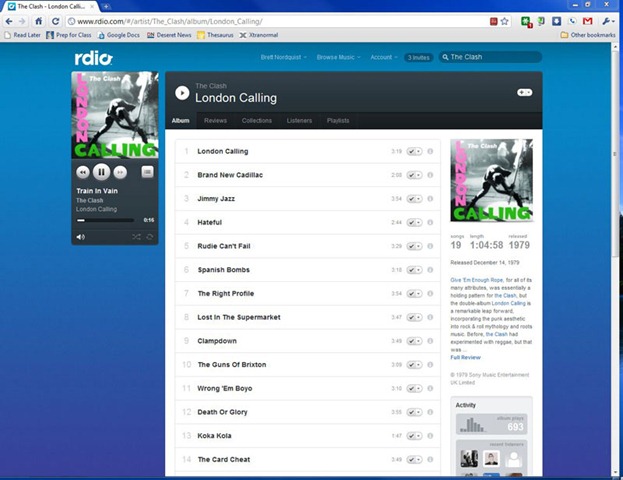
Or you can find an artist, such as the Clash, and play any song or album.

RDIO_Clash

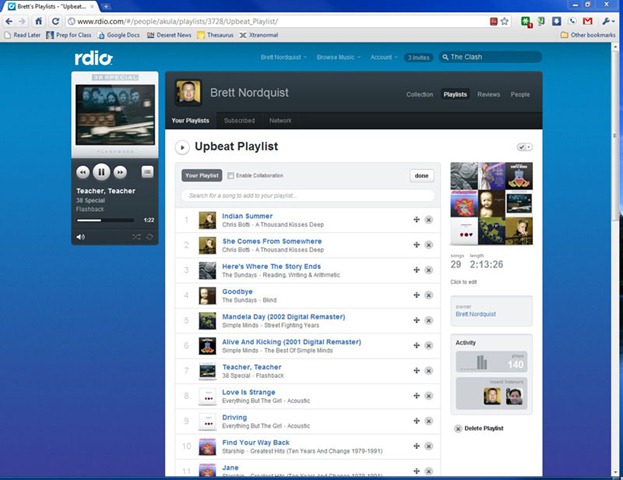
Rdio makes it easy to create a playlist like I’ve done below. Or you can queue up songs to play as you navigate through the service.

 RDIO_Playlist

Again, the focus is on ease of use. Rdio does not include as many tracking metrics found at Zune or Last.FM. I’m sure many of the social features of rdio will be fleshed out over time as the service moves out of beta.

As of today, you’ll need an invite in order to use rdio. I was able to test drive the service for about 20 days before deciding to pay the $5/month subscription fee. Another $5/month allows you to stream to your mobile device.

The service is not perfect. I’d like to see better playlist management and it never hurts to add more artists. I’m certain their library will continue to grow with the service, but it’s already quite good.

But I’m absolutely hooked on rdio. I listen to it while working at the computer at home as well as at work. It’s decreased the amount of money I spend at the Amazon MP3 store and iTunes. Also, I find using iTunes an exercise in frustration, but necessary evil which accompanies my decision to own an iPhone. Yet rdio feels modern and is a lot of fun to use.

Pros:

  • Simple and elegant design
  • Instant access to most any song or album
  • Easy playlist creation
  • Most competitors charge $15/month. Rdio is $5/month for web streaming and $10/month for web + mobile devices.
  • Can scrobble to my Last.FM account

Cons:

  • Obscure music tastes may not be a good match until catalog grows.
  • Occasional service slow downs
  • No way to create “stations”

If you’ve made it this far and would like to test drive rdio, leave a comment and I’ll email an invite to the first three. If I can convince rdio to give me more invites, I’ll hand those out as well.

Update: @kgoyette showed me that rdio does allow one to create stations based on an specific artist. Click on any artist and off to the right you’ll see “Artist Radio” which plays songs from artists in the “similar artist” section. Awesome!

Pay Phones

My parents lived less than 50 yards from McKay Dee Hospital. As a young boy, this provided a number of benefits. If I could convince my mom to give me 75 cents, I could buy a Ramlin Root Beer and a package of raspberry and coconut Zingers.

The other benefit came in the form of crank calling the bank of pay phones located just inside the hospital’s main entrance. I’d memorize the four phone numbers and use one phone to call the others. Passersby would tire of the ringing and take the bait. Seldom did I have much of a conversation with the pranked because my laughter would blow my cover. booth

It was all fun and games until a nurse or janitor called security. I can’t imagine how many times a uniformed security guard chased me down those carpeted hallways on my skateboard. No way does a middle aged, out-of-shape security guard catch a 12-year old mischief maker.

These were a few of my thoughts as we came across this working phone booth at Westport Marina this afternoon. My kids didn’t know what to make of it. They stared at it for a few minutes before going inside.

“Dad, why does the phone say 75 cents?”

“Because that’s what it costs if you want to make a call.”

“Why would someone pay to use a phone? And why’s the phone connected to a cord?”

Sadly, I was unable to find a number associated to this phone or I would have tried calling it from my iPhone. I considered telling my children about my past pay phone exploits. Explain why security chased me from the building.

But they will find out about my misspent youth soon enough.

I wonder what my son will do with his spare time when he turns 12 in a few years? Crank calling pay phones won’t be an option and that makes me sad.

Good thing I’m not out of bad examples to teach him.

Loop Around the Block

I never know if I should grab the short leash or the fancy retractable one. The short leash was the first to be found tonight, and I attached it to Elka’s collar and headed down the street for a short walk.

Our neighborhood is a maze of cul-de-sacs surrounded by large trees. Most homes were built in the late 70’s although many have been renovated to look new. Sidewalks will appear for a stretch and then disappear. It’s not uncommon to see children playing soccer in the streets.

Elka and I continued a few more blocks until we come to section marked by an elderly care facility. But it’s not just one large building. It feels like an upscale neighborhood with modern homes and apartments scattered around a lush wooded area. The streets are lined with retro lights, and not a blade of grass is out of place. It’s immaculately maintained.

Elka tugged at the leash when she heard the deep croaking coming from the bullfrogs. We kept moving as to not become an easy target for the mosquitoes.

I decided to loop around the block one more time.

I’m amazed at the care these people put into their homes. We passed one man watering a cart full of flowers he’d placed near the street for passersby to enjoy. Another woman was hanging a new bird feeder just outside her porch.

As we neared the cross street that would take us home, I noticed an elderly woman standing on her lawn. She held her right hand over her eyes to reduce the glare while using her other hand to grasp her walker.

I turned to catch the sky ablaze in color as it was about to disappear for the day. It looked as though the sky was covered in bright orange creamsicles.

“Good evening”, I said to the woman who was now moving towards us. She asked to pet Elka. I told her that was fine. Elka loves the attention. Her stubby tail wiggled back and forth in a fashion that still makes me laugh. 

Before we parted ways, we looked towards the sky one last time as the sun dropped below the horizon.

We stood there in silence. The colors disappeared. The clouds began to move in.

“I come out here each evening to watch the sunset. Because you never know when it might be your last”.

With that, she grabbed her walker with both hands and headed towards the porch at a pace that won’t make it easy for even the fleetest of mosquitoes.

Putting In The Time

Consider for a moment the talents you possess.

You may be skilled at playing the piano. Maybe you’re a talented dancer. My father excelled at working with teens. My father-in-law knows more about computers than anyone I know. Both of them made careers doing work they enjoyed and were talented at.

How much time each day do you spend practicing your most valuable talents?

I’ve been watching the World Cup over the past few weeks. Soccer is not a sport I follow on a regular basis, and I’ve enjoyed listening to the back stories of the players. Teams like England, Brazil, Spain and Argentina are filled with some of the best athletes in the world.

earlybeatles

There’s no doubt players like Messi, Ronaldo, and Kaka were born with athletic talent. But each of them spent their youth living and breathing soccer. When they weren’t eating or sleeping they were out in the streets or fields kicking the ball around. They’ve spent the majority of their lives perfecting their talents through many hours of practice.

I recently read a book by Stephen King called On Writing. One theme that came through loud and clear was how much work he put in before he become successful. Many people have asked for his advice on becoming a successful writer. As if all one must do is swallow a magic pill. His reply is blunt:

Read and write four to six hours a day. If you cannot find the time for that, you can’t expect to become a good writer.

Bill Simmons is a writer for ESPN. He is my favorite writer, and the one who has influenced me the most. On one of his podcasts he mentioned how much his writing suffers if he doesn’t put in at least four to six hours a day. And this from a guy who has written thousands of columns and several books. Try reading this piece he wrote about his dog without shedding a tear.

I’m reminded of a book I read last year from Malcolm Gladwell called  Outliers. Gladwell posits the “10,000 Hour Rule” which suggests success is based less on talent but more in putting in the hours, specially 10,000 of them. That’s 20 hours a week for 10 years.

He cites a number of examples including the Beatles who perfected their craft by playing hundreds of shows in Germany before hitting it big in the states. Or the many hours Bill Gates spent programming on an ASR-33 Teletype as a young boy.

Both the Beatles and Gates were talented. But all those hours of practice along with excellent timing allowed them to rise to the top in their fields.

I certainly haven’t spent even close to 10,000 hours writing. I’m still working to get to 20 hours a week. I’m currently at half that but moving in the right direction.

I wish I’d started earlier.