What’s Driving Windows 8 Pricing?

Today Microsoft announced that anyone with a copy of Windows XP, Vista, or Windows 7 can upgrade to Windows 8 Pro for $39.99.

My first thought was that this is a smart move my Microsoft. A low price may very well drive momentum for Microsoft’s newest and most controversial version of Windows in years.

Microsoft knows that Windows 8 is going to sell hundreds of millions of copies no matter the reception. Microsoft also knows that the last thing they need is a Vista-type reception that bleeds over into Surface and Windows Phone sales. That’s a downside of tying the Windows brand to as many devices as possible.

But the actual price of the upgrade have longer term effects on Microsoft bottom line because, although the jury is still out on whether Microsoft can becoming a player in smart phones and tablets, Windows will be around for many years. You can’t ignore the fact that Microsoft is dropping the price of Windows upgrades from $199 for Windows 7 Professional or $119 for Windows 7 Home Premium to forty bucks for Windows 8 Professional.

Does Microsoft expect to make up the difference in volume? Given projected PC sales that’s hard to imagine. Maybe pressure from the OEMs made Microsoft reconsider a lower price for Windows given decrease in average selling price of the PC.

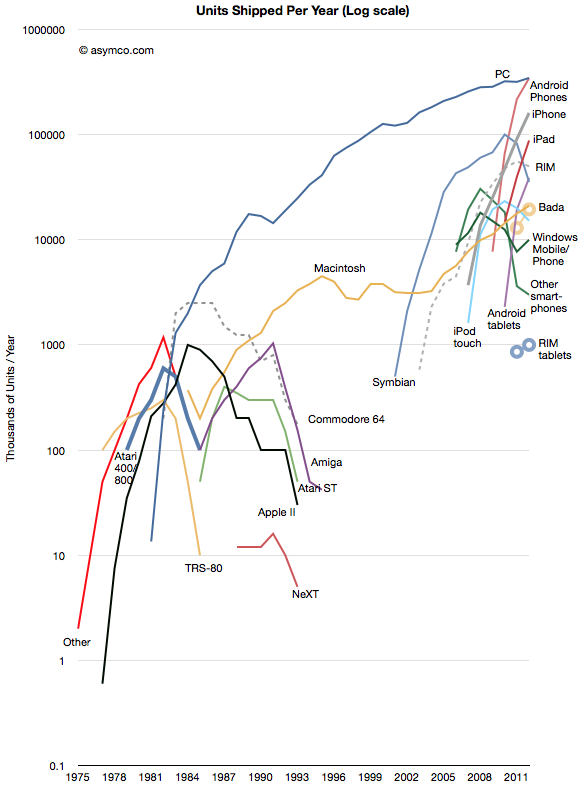
Whatever the reason, you can bet that Microsoft is feeling the heat. It’s been nearly 30 years since any competing platform has approached the PC in sales. But already this year, Android passed the PC in total units shipped and iOS is poised to follow. This chart from Horace Dediu at Asymco tells the story.

I always felt that the price of Windows should come down as the price of the PC decreased. But for many years, the opposite happened because Microsoft felt no competitive pressure to do so.

Could it be that by the time you realize you must lower your price it’s actually too late? It won’t take long to find out.

“You Can’t Do Real Work On An iPad”

This isn’t the first time I’ve heard this nor will it probably be the last. But I was surprised because it came from a man around my age who works as an IT manager for a large company. He began by explaining how frustrating his company’s new BYOD (Bring Your Own Device) initiative has been for his department.

He mentioned that a number of executives were looking to replace their bulky laptops with iPads after watching a number of employees bring them to meetings. Some employees were even leaving their laptops back in the office and going on the road with only an iPad.

But nobody’s doing work on them.

I’d normally jump with example after detailed example of how I use my iPad. But I’ve had those conversations and they’re a waste of time. There’s nothing I can say to change his mind. Of course, he didn’t actually own an iPad, but he was sure it was only good for Angry Birds, reading and web surfing. I chimed in with Netflix just to show I was listening.

This argument that one can’t complete real work on a tablet has run its course.  It also reminds me when I purchased my first PC that ran DOS. At least 90% of software stores were filled with PC games which gave the impression that was all they were good for. Friends without PC told me I’d bought a $2000 game machine.

My iPad didn’t replace my laptop because I never owned a laptop. It hasn’t replaces my Windows desktop either. I didn’t write this post on my iPad to prove a point although I could have. The point is that IT managers would do well to embrace tablets and all mobile devices instead of denigrate them.  I suspect those executives who want iPads spend much of their day reading emails and occasionally writing a short reply. Maybe they need to research a competitor or prepare for an interview. I doubt they editing HD video, rendering 3D objects or pushing Photoshop to its limits.

Use the device that works best for you. Just don’t try to tell me what I can’t do with my iPad.

Downcast for Podcasts

When I heard Apple plans to remove the podcasting functionally from iOS 6, I decided to see whatIMG_0842 other apps might feel the void. What I didn’t understand at the time was that Apple wasn’t far from releasing a standalone app called, well, Podcasts.

It’s not a terrible app and it’s free. If you occasionally listen to podcasts it won’t get in the way.

But it’s not great, and if you listen to a lot of podcasts (or a few religiously) you want a great app that’s responsive, makes searching and adding new podcasts a cinch, and automatically downloads new episodes in the background.

So my suggestion is to pony up the two bucks and grab the nifty Downcast that does all that and more. 

The best compliment I can give Downcast is that it’s earned a spot on my iPhone’s home screen.

“Priming the Pump”

“No comment”

Those were the words of Microsoft CEO, Steve Ballmer, when asked about the reaction of his PC partners when told of the Surface tablet.

Of course, this isn’t Microsoft’s first attempt at building their own hardware device running Microsoft software. They did it with the ill-fated Zune media player and with the successful Xbox console.

But what happened this evening at Milk Studios in Hollywood signals a much more pointed assessment of Ballmer’s trust in OEMs to compete head on with the best selling Apple iPad.

gallery_4_large

Neither Zune nor Xbox ran Windows as we know it, nor did they compete head to head with current Microsoft partners such as Dell and HP. No pesky channel conflict to be found.

But that all changed today.

Think about this for a moment: companies such as Dell, HP, Sony, Lenovo and many others will now be purchasing Windows licenses from the company they are competing against in the tablet market.  Ballmer tried to downplay the conflict referring to it as “priming the pump.”

I’d call it a partner butt kicking.

Today’s hastily called event showcased the many features of the Surface (which will be offered in both X86 and RT models), including the unique foldout keyboard that doubles as a cover as well as the integrated kickstand. But we were left in the dark on such items as price, availability and battery life.

What came across loud and clear from Ballmer and his team was this: “We’ll flood the earth with our own devices running Windows if we have to.” 

The iPad wasn’t mentioned today but it loomed large because every tablet will be compared to the leader dominating the market. But that may not be the correct comparison. With the included keyboard, USB port, and MicroSD,  the Surface appears to compete more with Ultrabooks than the iPad.

I don’t believe Microsoft wanted to design and build their own hardware. Software, not hardware, is in their DNA. They had no choice with Xbox and Zune. But today, Ballmer surveyed the scene, and sent a message to every one of his OEMs that Microsoft won’t stand on the sidelines and watch Apple release integrated devices that slow Windows growth and win over a generation who may never need Windows.

Much of Microsoft’s growth over the last 30 years can be attributed to the support of its hardware partners. Choice fueled growth of Windows and the integrated approach of Apple nearly faded into oblivion in the late 90’s.

But few, outside of Steve Jobs, could have predicted the meteoric growth of smartphones and tablets which reward tightly integrated systems. That the iPhone business is larger than all of Microsoft can’t sit well with the man who once derided it.

By melding Windows 8 with its own hardware, Microsoft took a page out of the Apple playbook.

And keep your eye on what’s happening with Nokia.

Surface Phone anyone?

Extend the Day

A couple months of language training in Provo, Utah gave me me false sense of hope that I could speak German. But when I finally arrived in Siegen, Germany to serve as a missionary I had no idea what I was hearing. It certainly didn’t sound like the German I studied back in the states.

I was difficult to appreciate my new home when I couldn’t understand the people around me. Our days were packed with teaching appointments and meetings from 6 am to 10 pm each day. Until I could speak German, my frustration would continue, but when would I have time to study?

I decided my only option was to extend the day.

For several months I got out of bed at 5 am to read through the lessons in my grammar book. When I got bored of that I looked up words in my English-German dictionary. Eventually I bought a thesaurus to help improve my writing.

One less hour of sleep didn’t seem like much, but took a toll on my mind and body. I had decided to sacrifice something (sleep, rest) in order to gain a skill. It wasn’t that I was this incredibly driven 19-year old. No, it was that I was concerned that I was falling behind the others, and I felt this internal panic I had to do something.

I thought about this experience when I began biking to work. It wasn’t exactly a convenient decision for the family as they would see me less each day. It has required more advanced planning to ensure sure I’m able to participate in the church and school activities with the kids.

Seattle provides a number of built-in excuses for not riding a bike. From the lack of bike lanes to the weather, I don’t have to search far for an excuse for why I should leave my bike at home and take the car.

And in a sense, I’m sacrificing time with my family in order to live a healthier lifestyle that I hope will pay dividends later…such as living longer to spend more time with my family.  My body often aches from the rides up the hill, but never to the point that I feel like giving up.

Too often I’ve searched for and found excuses on why I’m not in better shape. Playing racquetball or basketball never feels like a sacrifice because I enjoy both sports so much. But biking? I don’t enjoy it as much as my good friend who encouraged me to try it.

But like those early morning study sessions, I’m beginning to see progress.

Too Many Stations

I don’t know how many stations DirecTV pipes into my home. A hundred and fifty? Two fifty? No idea. I just know that whenever I get a new receiver, I spend several hours setting up which stations are visible from the onscreen guide. Few make the cut. propjoe

I could probably get by with ten stations. In fact, most days I could get by with three of them: ESPN, HBO, and AMC.

Other than live sports, I could do without NBC, ABC, CBS and Fox.  I occasionally watch Shark Tank, but the Office hasn’t been any good for several years now. The BBC version of the Office went out on top after two seasons and two specials. Leave it to NBC to run the show into the ground. I hardly recognize the characters anymore. Dwight was always so far out there, but Jim had something going for a while. Now he’s a one dimensional dud.

Sorry, I tried Modern Family and couldn’t get over a couple annoying characters.

Flip over to AMC and you have Breaking Bad and Mad Men. The Walking Dead is good. FX had the Shield and now Justified and Louie. Louie may be the best show you’re not watching.

Of course, I can’t leave Game of Thrones on HBO off the list of best shows. The intro to Game of Thrones has higher production values than most of the junk on the Big 4.

But the Wire stands above them all. It’s an investment to watch five seasons of a gritty drama with numerous story lines. But so well worth it.

Omar, Bunk, and Proposition Joe. What a show.

"No doubt”

Mount Rainier

When I’m in my car, I tend to listen to NPR or podcast or music. Anything to take my mind off traffic and make the trip feel shorter.

When I drive, I want to get to my destination as soon as possible. I seldom pay attention to my surroundings. I’m on auto-pilot much of the time. 

On my bike ride this morning I heard frogs. Very loud frogs hiding in the brush just off the side of the road.  Unlike the times when I drive, I enjoy finding ways to lengthen the distance of my bike route. With Cyclemeter I don’t worry about getting lost.

In the six years we’ve lived in Auburn, I’ve barely noticed this view of Mount Rainier just blocks away from our home until today. I pulled my bike off the side of the road and snapped this picture while the wild croaking continued.

rainier

The Joy of Baseball

“The other sports are just sports. Baseball is a love.”Bryant Gumbel

My son nudged me while I sat at my computer. I looked up to see him wearing the black baseball pants and socks I bought him last weekend. He also wore the hat his grandfather gave him;  the bill worked in just so.

Baseball brings back so many good memories. Like the time I smacked the ball over the outfielders head in t-ball for a certain home run but was called out when I failed to touch home plate. Or learning to spit sunflower seeds or spending hours playing catch with my dad until my hand hurt.

No other sport has planted itself in my memory like baseball. It’s the only sport where the equipment I used nearly 30 years ago, still means something, or the reason I’ve watched the Moneyball trailer at least 150 times.

Lincoln was heading off to his first baseball practice and he wanted my help tying his cleats. He pulled up a chair, and I slid his new black Nikes onto his feet and cinched up the laces. I showed him how to store his batting glove in his back pocket.

Of course, he was full of questions:

Why is being left-handed an advantage in baseball?

Why do baseball players chew sunflower seeds?

How do I throw a curve ball?

How long is one inning?

What position should I play?

I answered a few and left some for him to find the answers to. The strategy and unwritten rules of baseball are a major component of its enjoyment, and I want him to discover that on his own, just like my father allowed me to do.

I wasn’t able to attend his first practice, and honestly, wasn’t sure how much he’d enjoy a sport where there’s a fair amount of standing around waiting for the next pitch or batter. I explained to him that baseball isn’t like soccer or basketball where you’re always on the move and involved in dozens of plays each game.

Any worries I held disappeared shortly after he returned from practice with a smile on his face and a dozen more questions.

I didn’t tell him that the sunflower seeds were the only thing that kept me awake during games when I played center field and our best pitcher was on the mound.

A Sister’s Reaction

Nine months ago I escorted my daughter to a meeting at the middle school. In a few weeks she’d be starting 5th grade.  But on this night she’d be introduced to a number of instruments and be invited to join either the middle school band or orchestra.

The violin caught her attention. Then the viola. Then another instrument or two until she eventually decided on the cello.

Fast forward to tonight where we joined a gym full of nervous parents who were gathered to watch their children perform in the final concert of the school year. I thought back to the many early morning practices Luca attended while the rest of us were still in bed. Most mornings, it was my job to get her off to the bus stop where we had a few minutes to chat before the bus arrived.

Whether it’s the sounds coming the keys as she plays the piano or the vibration of the strings as she draws her bow over the face of the cello, I’m hearing something that burrows deep into my soul. Sure, I’m a proud father, but I’m mostly in awe of her passion and dedication for music, much like her mother.

So there we sat on the benches waiting for the students to arrive and take their seats on the gym floor in front of us. It was hot and muggy. Our kids, as well most adults, were having a hard time staying seated, and I began to wonder if the concert would outlast the battery on my iPhone.

A few minutes before the concert was to start, the students began filing in gym, instruments in tow. I looked for Luca but didn’t see her. Maybe the cellists come in after everyone else?

Without warning, Anna sprang to her feet and began yelling, “Luca!!! Luca!!! Luca!!!”

As Luca walked across the floor with her cello, Anna kept calling her name until she got closer, looked up and nodded at her sister.

Anna sat down with a big grin on her face that said, “Yep, that’s my sister”.

It’s been a full 24 hours, and I still smile when I think of how excited Anna was to see her big sister last night.

It’s hard to imagine this experience means much to anyone else, but I wanted to capture it. You know, before they hit their teens and can’t stand either other.

Competing on Price

Competing primarily on price isn’t a very fun way to run a business.

Unless you’re Walmart. But even then you don’t want to supply pickles to the behemoth.

Just over a year ago I worked for a company that competed solely on price. New employees were hired and given a few dollars above minimum wage. Each year benefits were reduced and more restrictions were placed on promotions. We may not be the best at what we did, but no way would anyone undercut our price!

It was a vicious cycle. A race to the bottom.

The work was technical in nature and not always easy to explain to those who were most in need of our services. Imagine going into a Best Buy and searching for a printer. The number of models and features are overwhelming to many buyers. In that state of confusion, many will select the “safe” option which tends to be the least expensive. I’ll bet the thinking goes something like “If I make a mistake, at least it won’t be an expensive one.”

We were the Walmart of our industry: big and cheap. Our prices were so low that we often had to explain how we stayed in business charging below-market rates. A number of customers assumed our low rates reflected subpar technical skills and took their business elsewhere.

Seth Godin refers to this as the tyranny of low price.

It’s been just the opposite at my current employer, Puget Systems.

Instead of competing on price we compete on quality and service. Our goal, starting from the owner on down, is to build the best quality PC we can. Sometimes that means intentionally choosing not to compete at every price point. Take the sub $750 desktop and laptop, products heavily advertised by Dell and HP, for example. We don’t offer a model in the price range, not because we can’t but because doing so would lead to a number of compromises in quality we aren’t willing to make.

What I’ve learned is that companies that compete solely on price seldom give their customers reason to look at anything but the bottom line. Companies such as Walmart, Amazon and even Costco can offer a low price and still survive but only if they grow so large that the massive quantities sold to make up for the low margins.

What separates your product or service from the competition besides price?